Twittering Machines Dieter Roelstraete, Berlin 2009
I have long thought (is that the word?) of my experience of viewing Marc Nagtzaam’s work as one of constructive, fruitful confusion; fitting testimony, it could be said, to the work’s profound and exemplary artistic quality -
for what is art other, in this day and age of endless conclusions, than an exercise in ambivalence and the practice of paradox, of producing doubt where so many other forms of knowledge (‘thought’) know and assert or accept only certitude?
This doubt of mine, let us call it an elegant type of ‘thoughtlessness’, concerns Marc Nagtzaam’s well-known ‘text-drawings’ first and foremost, and is best expressed in the following questions: are these works to be (‘merely’) looked at,
or to be read instead? Are they images, pictures, i.e. works of art in the conventional sense of pictorial representation, or are they texts - are they drawing or writing?
In an exhibition I organized at the Antwerp museum of contemporary art MuHKA in the fall of 2008 titled The Order of Things, this dilemma, which - in my capacity as a writer who (as a child) used to draw incessantly -
continues to intrigue me, was dramatized by the simple juxtaposition of a series of Nagtzaam’s drawings (let us for now agree that that is what they are: Nagtzaam is not a writer) with a well-known work by American
conceptual artist Sarah Charlesworth titled April 21, 1978, an ensemble of 45 black and white prints reproduced at the same size as the original newspapers whose front covers they depict. This mosaic of newspaper covers stoically
maps out the trajectory of a well-known photograph of Italian Prime Minister Aldo Moro, made while he was held in captivity by the Red Brigades, and dispersed by the hostage takers in newspapers around the world on April 21, 1978,
to “prove” that Moro was still alive following their previous day’s announcement of his assassination. The distinguishing feature of the work is that, title and date of publication of the newspaper in question aside, all text has been
deleted from these various front covers, keeping only the various photographs printed that day in place (the relative import of the Aldo Moro tragedy is then revealed by the size of the picture in relationship to photographs documenting
other events that took place around the world on that same day). On an opposing wall hung Marc Nagtzaam’s A Certain Amount of Words Within a Certain Amount of Time, pt. 2 & 3 (or rather, a selection of drawings culled from that body of work):
a ‘frieze’ made up of 23 + 10 pages containing meticulously hand-copied text fragments randomly chosen, or so it seems, from a wide variety of art and lifestyle magazines. Leaving considerations of the notion of the diaristic aside (for that is in essence what
these drawings are: diary entries, the fleeting reflections of the fleeting concerns of the day), the simple act of reading the actual fragments quickly revealed their provenance in a culture of desirable images in which words habitually occupy a far inferior
position - the images in question (of art works, bands, ‘things’, objects, situations, architecture), however, in turn erased from the fruits of Nagtzaam’s repetitive, reproductive labor. ‘Writing’ these drawings certainly are - but communication or
the straightforward transmission of content (‘information’) may not necessarily be their aim: selecting scattered fragments rather than more full-bodied swathes of text, Nagtzaam’s ‘writing’ stops short from actual ‘meaning’, hovering at the edge, not so much
of the legible, as of the comprehensible, reducing writing itself to a form of coded drawing - a balancing act of sorts. [We will be returning to this willed fragmentation shortly.]
These doubts and confusions and balancing acts - “almost always and nearly enough” - trigger the memory, not so much of the programmatic obfuscation of text and image typical of much canonical Concept Art (Art & Language, Robert Barry, Sol
LeWitt, Lawrence Weiner) to which Nagtzaam’s work is only tenuously related, let alone indebted (the only exception concerns LeWitt’s dedication to the monastic practice of a machine-like drawing - in the work of the other aforementioned artists,
the division between ‘art’ and ‘language’ is far too rigorous), but rather of a much older conundrum from the history of ideas - the duck-rabbit made famous in Ludwig Wittgenstein’s Philosophical Investigations:
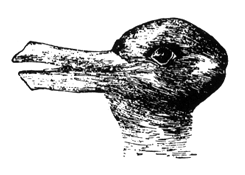
Just like Wittgenstein’s duck-rabbit is a visual reflection upon the art of looking (seeing something vs. seeing something as), Marc Nagtzaam’s drawings - for they are always, in the final analysis, drawings, even if their
images are made up out of words - are drawn reflections upon the art of drawing itself: thoroughly self-referential, yet no less aesthetically pleasing because of it, and therefore deeply inscribed in the history of modernism
(to which occasional reference is made) - made present most palpably (and pleasingly: Nagtzaam’s work is extremely, self-consciously beautiful) in the artist’s exploration of that most hallowed of modernist paradigms, the grid.
“The grid”, in Rosalind Krauss’ celebrated reflection upon the subject, is an established figure in avant-garde art practice that embodies some of modern and contemporary art’s longest-standing claims (the “myths” referred to
in the title of Krauss’ book The Originality of the Avant-Garde and Other Modernist Myths): its resistance to development on the one hand, and its imperviousness to language on the other - its imperious silence and refusal of
speech. “The absolute stasis of the grid, its lack of hierarchy, of centre, of inflection, emphasizes not only its anti-referential character, but - more importantly - its hostility to narrative”; certainly these are all
qualities easily applied to Marc Nagtzaam’s drawings - with the added twist, of course, of their use of language (the very stuff of ‘narrative’) as the grid’s omnipresent constituent element: words that cannot help but “making sense.” What
does a “refusal of speech” sound like, indeed, when the muteness of the grid is made up of words?
The world of sound, incidentally, provides a useful set of allegorical tools for manoeuvring the (very soundless) world of Nagtzaam’s minimalist drawings: these minutely planned works on paper resound and resonate with a plethora of
images culled from the fantastical realm of the musical imagination, sometimes invoking or resembling scores (as residues of musical notation - think of the graphic scores of Earle Brown and Cornelius Cardew among others), strings,
anechoic chambers or the rhythmic rolling of the dice, sometimes more directly referencing both the music of the spheres and the spheres of music by being titled “Minimal Compact”, “Extended Play” or “Discotheque”. [My visit to the
artist’s studio was set to a great soundtrack indeed: his drawings are not only there to be read, they can also be heard or listened to: looking at them is much like cupping one’s ears to catch their twittering.]
So while we may think of his work as inscribed in a great tradition that also encompasses the work of the aforementioned Sol LeWitt, as well as that of of Niele Toroni, Paul Klee (the author of the original Twittering Machines),
On Kawara and John Baldessari’s endlessly repeated (but, crucially, never truly boring) mantra “I will not make any more boring art” their mathematical compulsions bordering on the pathological, seem especially relevant with regards
to the diaristic impulse in, and additive dimension of, Nagtzaam’s art - it is another kind of mantric practice that appears more salient in our experience of the work, one that involves the spectral art of the Tibetan mandala for
instance, with its mystical overtones of drawing as a meditative technique of self-effacement, of disappearance - enter the droning sound of the Tibetan prayer bowl.
Continuing along this track of sonic imaginings, there is also the role played by improvisation in Nagtzaam’s draftsmanship: the obvious constraints of the grid’s structural austerity notwithstanding, there is a degree of playful
(yet all the more radical) freedom to Nagtzaam’s luminous compositions that lends his work an organic, entropic feel seemingly at odds with his preference for an angular, machinic minimalism - I have named the rolling of the dice before
(an image with obvious ludic overtones), but I could also call forth the soundless scattering of Mikado sticks (or of those sticks used for I Ching-style divination for instance). Indeed, Nagtzaam is only marginally interested in systems,
series and permutations, nor does he care much for the accidental poetry and serendipitous beauty of mathematics - a popular love interest among practitioners of conceptually inflected drawing, but not a feeling, it should be noted, that
is often returned by mathematicians. To once again put it in musical terms - dangerous but inevitable - the luminous, airy quality in his work more closely resembles the free-flight ethos of aleatory music or chamber jazz (I am tempted to
think back of the Jackson Pollock painting that first graced Ornette Coleman’s landmark Free Jazz album, or, more appropriately perhaps, the Juanita Giuffre painting on the cover of the Jimmy Giuffre Trio’s fantastic Free Fall) than the
often lifeless, soul-drained puritanical experiments of serialism in the Pierre Boulez mould. The fuzzy logic of clicks, cuts and crackling radio waves rather than clear-cut zeroes and ones. [Although - and this is a hunch worth exploring
in another thought experiment - the hard ‘graphic’ nature of some of the drawings does call forth the business-like spirit of statistics, as well as the emptied montage-like structure of comic books.] Hence the slow, half-imperceptible yet
irresistible rise, in Nagtzaam’s visual imagination, of the figure of the circle and the infinitely circular and spiraling - a self-administered antidote to the grid’s potential for absolute sterility (‘squareness’), or a definitive symbol
of playfulness pure and simple? Playfulness pure and simple or a cipher of the dizzying, labyrinthine nature of the artistic act itself - like the fabled (or plain notorious) Gordian knots that played such a prominent role in Jacques Lacan’s
late teaching, representing the perennially unentangible? Whatever its signifying function, this ‘noodling’ trope in turn resonates with echoes of Brice Marden, Pollock and Cy Twombly, or (again, more literally) of the circular breathing technique
pioneered by many elite corps members of the improvised music scene: eternally repeated, but no less different - and differentiating - for it.
In other words (and just as inevitably): “difference and repetition” - and let us conclude this ramble with a quote by that most musical of twentieth-century philosophers, Gilles Deleuze, picked from his magnum opus Mille Platteaux, which
he co-authored with Felix Guattari (a book that famously includes a chapter on choral and bird song, on ‘twittering’): “For sublime deeds like the foundation of a city or the fabrication of a golem“ - we are free to add “the creation of a work of
art” to this list - “one draws a circle, or better yet walks in a circle as in a children’s dance”. And what else is dancing but the body’s chant of freedom from the bounds of certainty, knowledge and thought - “freedom from the known,” as Krishnamurti would have it?
To round up and off, let us turn back once more to the grid as read and administered by Rosalind Krauss - more specifically regarding its relationship to fragmentation: “logically speaking, the grid extends, in all directions,
to infinity. Any boundaries imposed upon it by a given painting or sculpture can only be seen - according to this logic - as arbitrary. By virtue of the grid, the given work of art is presented as a mere fragment, a tiny piece
arbitrarily cropped from an infinitely larger fabric.” [My italics, DR.]
I have often felt that the immense popularity of Walter Benjamin in the current cultural climate (it is worth reminding ourselves that only three decades or so ago, this philosopher of minor things was himself considered a minor
figure in twentieth-century thought - perhaps a more truthful assessment, and not necessarily a bad one) is primarily grounded in the man’s uncanny sensitivity to, and, conversely, deployment of, the aesthetic of the fragment -
one need only briefly leaf through his magnum opus, Das Passagenwerk, to understand the drift of my argument. This, indeed, will perhaps be remembered, centuries from now, as Benjamin’s greatest achievement: to have made the
fragment, the fragmentary and fragmentation, into the central philosophical obsession of the post/modern era - and the delineation of the modern as something prior to the postmodern is itself defined in terms of a greater or
lesser fragmentation (hence the attraction of Benjamin’s scattered, and scattering, thought to postmodern doxa). For our present-day fate truly rests with the fragment - more disconcertingly still, the fragment seems to have become
our only remaining form (or shadow) of totality.
In Nagtzaam’s shimmering, rippling grids, the notion of the fragment relates to this (lost) totality - the “infinitely larger fabric from which a tiny piece was arbitrarily cropped” - in a manner reminiscent of
both mapping (we already named the necessity of ‘maneuvering’ or navigating his soundscapes) and measuring. What does one do when either lost in totality, or when all totality is lost and only a single shard remains?
We count our steps (and there seems to be a lot of counting in Nagtzaam’s work, if only on the viewer’s part) or draw a map of our immediate surroundings (and many of his drawings may resemble directions, if only in the beholder’s eye) -
or simply count our steps to map and measure these surroundings. The infinite riches of variation in Marc Nagtzaam’s seriously serial work resembles the painstaking labor of piecing the puzzle of such a world back together again.
Bibliography: Rosalind Krauss, “Grids”, in: The Originality of the Avant-Garde and Other Modernist Myths, Cambridge, Mass.: The MIT Press, 1986, p. 8-22.
Discography: Cornelius Cardew, “Treatise (Pages 21 & 2)”, on: Material, Basel: HatHut Records, 2004.