Twittering Machines Dieter Roelstraete, Brussels 2008
I have long thought of my experience of viewing Marc Nagtzaam's work as one of ambivalence, doubt
and polarization; fitting testimony, it could be said, to the work's profound and exemplary
artistic quality - for what is art other, in this day and age of endless conclusions, than an
exercise in ambivalence and the practice of producing doubt where knowledge ('thought') knows and
asserts only certitude?
This doubt or 'thoughtlessness' concerns Marc Nagtzaam's well-known 'text-drawings' first and
foremost, and is expressed in the following questions: are these works to be ('merely') looked at,
or to be read instead? Are they images, pictures, i.e. works of art in the conventional sense of
pictorial representation, or are they texts - drawing or writing? These queries trigger the memory,
not so much of the programmatic obfuscation of text and image typical of much canonical Concept Art
(Art & Language, Robert Barry, Sol LeWitt, Lawrence Weiner) to which Nagtzaam's work is only
tenuously related (namely in LeWitt's dedication to the monastic practice of machine-like drawing),
but rather of a much older conundrum from the history of ideas - the duck-rabbit made famous in
Ludwig Wittgenstein's Philosophical Investigations:
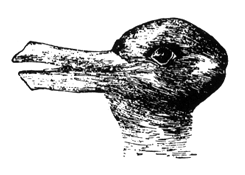
Just like Wittgenstein's duck-rabbit is a visual reflection upon the art of looking (seeing
something vs. seeing something as), Marc Nagtzaam's drawings - for they are always, in the final
analysis, drawings, even if their images are made up out of words - are drawn reflections upon the
art of drawing itself: thoroughly self-referential, yet no less aesthetically pleasing because of
it, and therefore deeply inscribed in the history of modernism - made present most palpably (and
pleasingly - Nagtzaam's work has an extreme quality of pristine beauty) in the artist's exploration
of that most hallowed of modernist paradigms, the grid.
"The grid", in Rosalind Krauss' celebrated reflection upon the subject, is an established figure in
avant-garde art practice that embodies one of modern and contemporary art's longest-standing claims
(the "myths" referred to in the title of Krauss' book The Originality of the Avant-Garde and Other
Modernist Myths) - that of its imperviousness to language, its imperious silence ("Silence, exile,
and cunning", in the words of another prototype of Modernist heroism, James Joyce's alter ego
Stephen Dedalus), its refusal of speech. "The absolute stasis of the grid, its lack of hierarchy,
of centre, of inflection, emphasizes not only its anti-referential character, but - more
importantly - its hostility to narrative"; certainly these are all qualities easily applied to Marc
Nagtzaam's drawings - with the added twist, of course, of their use of language (the very stuff of
'narrative') as the grid's omnipresent constituent element. What does a "refusal of speech" sound
like, indeed, when the muteness of the grid is made up of words? ['Sound', incidentally, provides a
useful set of allegorical tools for manoeuvring the soundless world of Nagtzaam's pseudo-minimalist
drawings: these meticulously planned works on paper resound and resonate with images culled from
the fantastical realm of the musical imagination, resembling scores, strings, anechoic chambers.
And my visit to the artist's studio was set to a great soundtrack indeed.]
A great variety of names, images and memories flit through my mind: we've mentioned the late Sol
LeWitt before, but we may also think back of Niele Toroni, Paul Klee, On Kawara and John
Baldessari's endlessly repeated (but, crucially, never truly boring) mantra "I will not make any
more boring art". And while on the subject of mantras, there is of course also the spectre of the
Tibetan art of the mandala, with its mystical overtones of drawing as a meditative, self-effacing
technique - but perhaps that is just a spectre, and should be left at that. [The same holds true
for concepts borrowed from the realm of psychopathology - compulsion, neurosis, repetition.] What
about measurements, graphs, and Morse codes? Systems of motoric notation such as the "Benesh
Choreology"?
Finally, riding our train of thought back into the sphere of sonic imaginings, there is the role
played by improvisation in Nagtzaam's draughtsmanship: the obvious constraints of the grid's
structural austerity notwithstanding, there is a degree of playful (yet all the more radical)
freedom to Nagtzaam's luminous compositions that lends his work an organic feel only superficially
at odds with his preference for an angular, machinic minimalism. Nagtzaam is only marginally
interested in systems, series and permutations, nor does he care for the accidental poetry of
mathematics - a popular love interest among conceptually inflected drawing artists. To once again
put it in musical terms, his work more closely resembles the free-flight ethos of aleatory music or
jazz even (I am tempted to think back of the Jackson Pollock painting that first graced Ornette
Coleman's landmark Free Jazz album, or - more appropriately - the Juanita Giuffre painting on the
cover of the Jimmy Giuffre Trio's fantastic Free Fall) than the often lifeless, soul-drained
puritanical experiments of serialism. Hence the slow, half-imperceptible yet irresistible rise, in
Nagtzaam's visual imagination, of the figure of the circle and the infinitely circular - a
self-appointed antidote to the grid's potential for sterilization? A definitive symbol of
playfulness pure and simple? - a trope resounding with echoes of Brice Marden, Pollock and Cy
Twombly, or (more literally) of the circular breathing technique pioneered by many elite corps
members of the improvised music scene. Eternally repeated, but no less different - and
differentiating - for it.
"Difference and repetition" - let us conclude with a quote by that most musical of
twentieth-century philosophers, Gilles Deleuze, picked from his magnum opus Mille Platteaux, which
he co-authored with Felix Guattari: "For sublime deeds like the foundation of a city or the
fabrication of a golem" - we are free to add "the creation of a work of art" to this list - "one
draws a circle, or better yet walks in a circle as in a children's dance". And what else is dancing
but the body's song of freedom, from the bounds of certainty, knowledge and thought?